

It happens almost overnight. A decent bit of rain rolls through the Sunshine Coast, and by morning your lawn looks like a miniature volcano field: dozens of sandy, funnel-shaped mounds scattered across grass that was perfect a week ago. If that sounds familiar, you've got funnel ants in your lawn, and you're in very good company: they're one of the most common lawn complaints Mick hears from homeowners between Coolum and Mountain Creek.
The good news? Funnel ants are one of the most fixable lawn pests there is, when they're treated properly. This guide covers what funnel ants actually are, why they always seem to show up after rain, why the supermarket sprays keep failing you, and what a treatment that lasts years looks like.
What Are Funnel Ants?
Funnel ants (Aphaenogaster species) are native Australian ants, brownish-tan in colour and around 4–5 mm long. You'll rarely notice the ants themselves: they're timid, mostly stay underground, and aren't aggressive towards people or pets. What you notice is their earthworks.
Each colony digs an extensive network of tunnels and galleries beneath the turf, and the entrances take the shape of the funnel-like craters that give the ant its name: loose sandy cones that can reach several centimetres across. One lawn can host a network with dozens of active funnels, and the tunnelling extends well beyond the mounds you can see.
📌 Key fact: Funnel ants don't eat your grass. The damage is structural: their digging undermines the root zone, so the lawn goes soft and spongy, the surface turns lumpy and uneven, and mounds smother patches of turf. It's death by excavation, not by chewing.
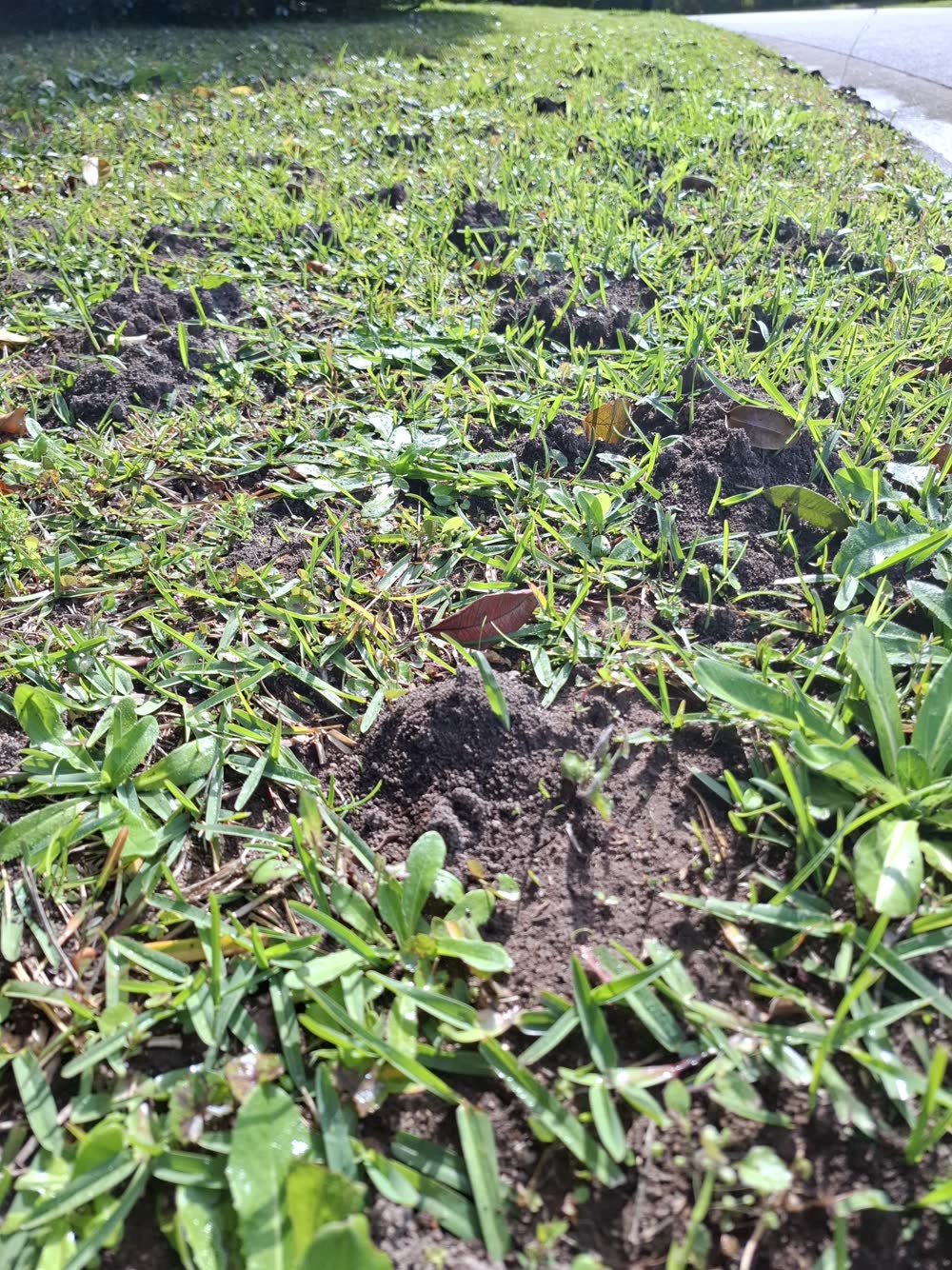
Classic funnel ant mounds in a local lawn: the tell-tale sign of an active colony network below.
Why Do Funnel Ants Appear After Rain?
The number one question: because the timing is uncanny. Rain, then mounds. Every time. There are two reasons for it:
1. Repairs. Heavy rain floods and partially collapses the shallow parts of the colony's tunnel system. As soon as the weather clears, the workers get busy re-excavating, and every scoop of soil they clear from the tunnels gets pushed up to the surface. Those fresh funnels are essentially the colony's renovation skip bins.
2. Easy digging. Moist soil is dramatically easier to tunnel through than dry, compacted ground. A wet week is prime time for the colony to expand its network, which means more spoil pushed to the surface, and more mounds.
So the rain isn't causing the funnel ants: it's revealing them. The colony was there all along. If your lawn erupts after every downpour, you have an established network underneath, and it will keep happening until the colony itself is dealt with.
The Real Cost of Ignoring Them
Funnel ants won't sting the kids or invade the pantry, so it's tempting to file them under "harmless". Sunshine Coast lawns tell a different story. Left unchecked, an expanding colony network leads to:
- Spongy, collapsing ground: the classic "walking on a sponge cake" feeling as the soil structure is hollowed out
- Mower damage: wheels sinking into soft patches and blades scalping the tops off mounds, leaving bald spots
- Uneven, hazardous surfaces: ankle-roll territory for kids playing and anyone mowing on a slope
- Smothered turf: every mound buries the grass beneath it, opening bare patches for weeds to move into
- Undermined paths and pavers: heavy activity along lawn edges can leave paving unsupported
A lawn that's taken years to establish can end up needing levelling and re-turfing: a bill that makes professional ant treatment look like pocket change.
Why DIY Funnel Ant Products Keep Failing
Almost everyone who calls Mick about funnel ants has already been through a few rounds with retail granules or surface sprays. The pattern is always the same: treat the mounds, enjoy two quiet weeks, then watch fresh funnels pop up a few metres away. Here's why:
| DIY Retail Products | Professional Soak Treatment | |
|---|---|---|
| What it reaches | Workers near the surface of visible mounds | The whole gallery network, including areas between and beyond the mounds |
| Effect on the colony | Colony survives and re-routes around treated spots | Treatment reaches the colony where it lives |
| Typical result | Quiet for weeks, then mounds return | Lawns commonly stay clear for years |
| Cost over time | Repeat purchases, several times a year | One treatment: $250 for a regular block |
The short version: funnel ant control is a volume game. The colony network is deep and spread out, so the treatment has to be flooded down into it, not sprinkled on top of it.
What a Treatment That Lasts Years Looks Like
A professional funnel ant treatment is a high-volume soak: a registered residual insecticide mixed and applied at serious volume (around 100 litres for a typical suburban lawn), flooded through the funnels and across the whole affected area so it penetrates the gallery network where the colony actually lives.
Done properly, the results speak for themselves. Mick has customers around the Sunshine Coast whose lawns are still funnel-ant-free more than 10 years after a single treatment. Two jobs he still talks about involved rain: one finished just before a downpour, one interrupted by rain halfway through. He fully expected to be back to redo both. Both lawns have stayed clear for over 8 years and counting. Once the treatment is soaked down where the colony lives, even a badly timed shower doesn't stop it doing its job.
💰 Pricing: Funnel ant treatment is $250 for a regular house block (up to 100 L of treatment). Larger blocks and acreage: $250 for the first 100 L, then $150 per additional 100 L. Full details on the funnel ant treatment page.
Funnel ants thrive in sandy, free-draining soils, which is exactly what most of the coastal strip sits on. Lawns in Maroochydore, Mudjimba, Twin Waters and Bli Bli are prime funnel ant territory, though established colonies turn up everywhere from Nambour to Mountain Creek.
Funnel Ant FAQs
Do funnel ants sting?
They're capable of a nip if you handle them, but funnel ants are timid and non-aggressive, nothing like fire ants. They're not considered a health threat to people or pets. The damage they do is to lawns, not to the family.
Can I just flatten the mounds with the mower or a rake?
You can tidy the surface, but the colony underneath doesn't care: the funnels will be rebuilt after the next rain, often within a day or two. Raking mounds is lawn cosmetics; it does nothing about the network that keeps producing them.
Is the treatment safe for kids and pets?
Yes, professional products registered for residential turf use, applied to label. Keep everyone off the lawn while it's wet; once it's dried, normal backyard life resumes. You'll get clear re-entry advice on the day.
How soon after treatment will the mounds stop?
Activity typically drops away over the following weeks as the treatment works through the colony network. Existing mounds can be raked out once the lawn has dried, and if the treatment has done its job, they aren't rebuilt.
My whole street has funnel ants. Is treating just my lawn pointless?
Not at all. Colonies spread slowly, and the residual treatment in your soil keeps working against newcomers: Mick's treated lawns stay clear for years even on streets where every other nature strip is full of funnels. That said, neighbours treating at the same time gives the best long-term result for the whole street.
Ready to Get Your Lawn Back?
Funnel ant treatment from $250, with results Mick's customers are still enjoying 10 years later.
Owner-operated • Family & pet safe • Servicing the whole Sunshine Coast
📞 Call Mick: 0401 166 155Licensed PMT5005626616 • Or learn more about funnel ant treatment